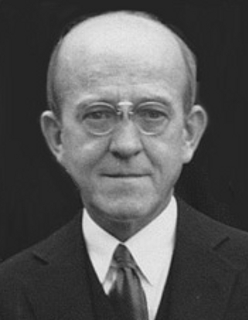
Oswald Avery
Full Name: Oswald Theodore Avery Jr.
Birthdate: October 21, 1877
Birthplace: Halifax, Nova Scotia, Canada
Date of Death: February 20, 1955
Occupation: Geneticist, Molecular Biologist, and Physician
Profile: Best known for the experiment (with Colin MacLeod and Maclyn
McCarty) that isolated DNA as the material of which genes and chromosomes are made.
Website: http://www.dnaftb.org/17/bio.html
Number of Quotes: 8
Biologists have long attempted to analyze the phenomena of growth and reproduction of the cell in terms of enzyme reactions and genetic
alterations. But progress is slow in the absence of more precise knowledge of the properties of the substances responsible for these effects.
From Avery, MacLeod, and McCarty’s 1944 paper Studies on the Chemical Nature of the Substance Inducing Transformation of Pneumococcal Types.
If the results of the present study on the chemical nature of the transforming principle are confirmed, then nucleic
acids must be regarded as possessing biological specificity the chemical basis of which is as yet undetermined.
If we are right, and of course that’s not yet proven, then it means that nucleic acids are not merely structurally important
but functionally active substances in determining the biochemical activities and specific characteristics of cells.
Private correspondence (1943), reflecting on his team’s groundbreaking findings about DNA.
It’s lots of fun to blow bubbles,—but it’s wiser to prick them yourself before someone else tries to.
From a 1943 letter to his brother Roy, cautioning against overconfidence in unverified scientific claims.
The evidence presented supports the belief that a nucleic acid of the desoxyribose type is the fundamental unit of the transforming principle.
Conclusion of the 1944 paper, cautiously asserting DNA’s role in heredity (a revolutionary claim at the time).
The inducing substance, on the basis of its chemical and physical properties, appears to be a highly polymerized and viscous form of sodium
desoxyribonucleate. On the other hand, the Type m capsular substance, the synthesis of which is evoked by this transforming agent, consists chiefly of
a non-nitrogenous polysaccharide constituted of glucose-glucuronic acid units linked in glycosidic union. The presence of the newly formed capsule
containing this type-specific polysaccharide confers on the transformed cells all the distinguishing characteristics of Pneumococcus Type III. Thus, it is
evident that the inducing substance and the substance produced in turn are chemically distinct and biologically specific in their action and that both are
requisite in determining the type of specificity of the cell of which they form a part. The experimental data presented in this paper strongly suggest that
nucleic acids, at least those of the desoxyribose type, possess different specificities as evidenced by the selective action of the transforming principle.
This [DNA] substance is highly reactive and in the pure state is capable of inducing unencapsulated cells to produce a capsular polysaccharide.
Explanation of the transformative power of DNA in his 1944 paper.
Whenever you fall, pick something up.

 Last on Earth