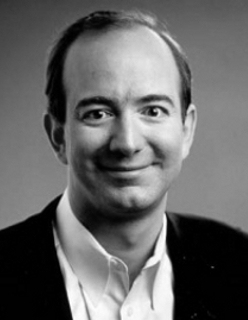
Jeff Bezos
Full Name: Jeffrey Preston Bezos
Birthdate: January 12, 1964
Birthplace: Albuquerque, New Mexico, USA
Occupation: Businessman
Profile: Founder of http://www.amazon.com.
Website: http://www.amazon.com
Number of Quotes: 131
A brand for a company is like a reputation for a person. You earn reputation by trying to do hard things well.
A company shouldn't get addicted to being shiny, because shiny doesn't last.
A life of stasis would be population control, combined with energy rationing. That is the stasis world that you live in if you stay. And even with improvements in
efficiency, you'll still have to ration energy. That, to me, doesn't sound like a very exciting civilization for our grandchildren's grandchildren to live in.
All businesses need to be young forever. If your customer base ages with you, you're Woolworth's.
Amazon.com strives to be the e-commerce destination where consumers can find and discover anything they want to buy online.
Base your strategy on things that won't change.
Often referencing customer desire for low prices, vast selection, fast delivery.
Beautiful speech doesn't need protection, it's ugly speech that needs protection. We have these cultural norms that allow
people to say really ugly things. You don't have to invite them to your dinner party, but you should let them say it.
Because, you know, resilience - if you think of it in terms of the Gold Rush, then you'd be pretty depressed right now because the last nugget of gold
would be gone. But the good thing is, with innovation, there isn't a last nugget. Every new thing creates two new questions and two new opportunities.
But there's so much kludge, so much terrible stuff, we are at the 1908 Hurley washing machine stage with the Internet.
That's where we are. We don't get our hair caught in it, but that's the level of primitiveness of where we are. We're in 1908.
Cleverness is a gift, kindness is a choice.
Complaining is not a strategy. You have to work with the world as you find it, not as you would have it be.
Cultures, for better or worse, are very stable.
Customers are always beautifully, wonderfully dissatisfied, even when they report being happy and business is great.
Disagree and commit.
A key Amazon leadership principle.
Ebooks had to happen.
Failure and invention are inseparable twins.
For many people, extended reading sessions on an LCD display cause eyestrain.
For people who are readers, reading is important to them.
Frugality drives innovation.
Great industries are never made from single companies. There is room in space for a lot of winners.
Humans are unbelievably data efficient. You don't have to drive 1 million miles to
drive a car, but the way we teach a self-driving car is have it drive a million miles.
I believe you have to be willing to be misunderstood if you're going to innovate.
I don't know about you, but most of my exchanges with cashiers are not that meaningful.
I don't know all the future steps, but I know one of them: we need to build a low-cost, highly operable, reusable launch
vehicle. No matter which path we take, it has to include that gate, and so that's why that's Blue Origin's mission.
I don't want to use my creative energy on somebody else's user interface.
I grew up reading science fiction.
I have won this lottery. It's a gigantic lottery, and it's called Amazon.com. And I'm using my lottery winnings to push us a little further into space.
I knew that if I failed I wouldn't regret that, but I knew the one thing I might regret is not trying.
I like having the digital camera on my smart phone, but I also like having a dedicated camera for when I want to take real pictures.
I read The High Frontier
in high school. I read it multiple times, and I was already primed. As soon as I read it, it made sense
to me. It seemed very clear that planetary surfaces were not the right place for an expanding civilization inside our solar system.
I strongly believe that missionaries make better products. They care more. For a missionary, it's not just about the business. There has to be a
business, and the business has to make sense, but that's not why you do it. You do it because you have something meaningful that motivates you.
I think frugality drives innovation, just like other constraints do. One of the only ways to get out of a tight box is to invent your way out.
I think that, ah, I'm a very goofy sort of person in many ways.
I think the definition of a book is changing.
I think there are going to be a bunch of tablet-like devices. It's really a different product category.
I very much believe the Internet is indeed all it is cracked up to be.
I went to Princeton specifically to study physics.
I'm a big fan of all-you-can-eat plans, because they're simpler for customers.
I'm skeptical of any mission that has advertisers at its centerpiece.
I'm skeptical that the novel will be re-invented.
I've always been at the intersection of computers and whatever they can revolutionize.
If someone thinks they are being mistreated by us, they won't tell 5 people, they'll tell 5000.
If you can't feed a team with two pizzas, it's too large.
If you can't tolerate critics, don't do anything new or interesting.
If you decide that you're going to do only the things you know are going to work, you're going to leave a lot of opportunity on the table.
If you do build a great experience, customers tell each other about that. Word of mouth is very powerful.
If you don't understand the details of your business you are going to fail.
If you double the number of experiments you do per year, you're going to double your inventiveness.
If you never want to be criticized, for goodness' sake don't do anything new.
If you only do things where you know the answer in advance, your company goes away.
If you're competitor-focused, you have to wait until there is a competitor doing something. Being customer-focused allows you to be more pioneering.
If your customer base is aging with you, then eventually you are going to become obsolete or irrelevant. You
need to be constantly figuring out who are your new customers and what are you doing to stay forever young.
If your payloads cost hundreds of millions of dollars, they actually cost more than the launch. It puts a lot of pressure on the launch
vehicle not to change, to be very stable. Reliability becomes much more important than the cost. It's hard to get off of that equilibrium.
In just a few hundred years, we will have to cover the entire surface of the Earth in solar cells if we want to continue to grow our energy usage.
In the end, we are our choices.
In this industry, there's a lot of cases of being a competitor in one way, but you're often a customer and a
vendor in another way. It's not atypical in aerospace. Actually, it's not that atypical in a lot of industries.
Infrastructure web services had to happen.
Innovation is disruption.
It is harder to be kind than clever.
Princeton Commencement Address, referencing his grandfather.
It is very difficult to get people to focus on the most important things when you're in boom times.
It's not an experiment if you know it’s going to work.
Life's too short to hang out with people who aren't resourceful.
Maintain a firm grasp of the obvious at all times.
Market leadership can translate directly to higher revenue, higher profitability,
greater capital velocity, and correspondingly stronger returns on invested capital.
Mediocre theoretical physicists make no progress. They spend all their time understanding other people's progress.
Millions of people were inspired by the Apollo Program. I was five years old when I watched Apollo 11 unfold on
television, and without any doubt it was a big contributor to my passions for science, engineering, and exploration.
Most of our important decisions are made with less than 70% of the information we wish we had.
My own view is that every company requires a long-term view.
My view is there's no bad time to innovate.
Obsess about customers, not competitors.
Of course humans like to explore, and we should. There's nothing wrong with that. But
it's more than that. It's essential for your children and your children's children.
On the Internet, companies are scale businesses, characterized by high fixed costs and relatively low variable costs. You can be two sizes: You can be big, or
you can be small. It's very hard to be medium. A lot of medium-sized companies had the financing rug pulled out from under them before they could get big.
One of the things that I'm very excited about with New Shepard, which is our suborbital tourism vehicle, is using that to
get a lot of practice. One of the equilibria that we're at today with space launch is that we don't get to practice enough.
One thing that I find very unmotivating is the kind of Plan B argument: when Earth gets destroyed, you want to be somewhere
else. That doesn't work for me. We have sent robotic probes now to every place in the solar system, and this is the best one.
Our motto at Blue Origin is Gradatim Ferociter
: Step by Step, Ferociously.
Our success at Amazon is a function of how many experiments we do per year, per month, per week, per day.
Part of company culture is path-dependent - it's the lessons you learn along the way.
People forget already how much utility they get out of the Internet - how much utility they get
out of e-mail, how much utility they get out of even simple things like brochureware online.
People who are right a lot of the time are people who often change their minds.
People will visit Mars, they will settle Mars, and we should because it's cool.
Percentage margins don't matter. What matters always is dollar margins: the actual dollar amount. Companies
are valued not on their percentage margins, but on how many dollars they actually make, and a multiple of that.
Real estate is the key cost of physical retailers. That's why there's the old saw: location, location, location.
Stress primarily comes from not taking action over something that you can have some control over.
Strip malls are history.
The Apollo program certainly had no real commercial value. It was done for very different reasons and, I
think, very good reasons for the time. It's an extraordinary achievement of mankind, but it wasn't sustainable.
The best customer service is if the customer doesn't need to call you, doesn't need to talk to you. It just works.
The book is not really the container for the book. The book itself is the narrative. It's the thing that people create.
The common question that gets asked in business is,Why?
That’s a good question, but an equally valid question is, Why not?
The human brain is an incredible pattern-matching machine.
The key thing about a book is that you lose yourself in the author's world.
The killer app that got the world ready for appliances was the light bulb. So the light bulb is what
wired the world. And they weren't thinking about appliances when they wired the world. They were really
thinking about - they weren't putting electricity into the home. They were putting lighting into the home.
The one thing that offends me the most is when I walk by a bank and see ads trying to convince
people to take out second mortgages on their home so they can go on vacation. That's approaching evil.
The question really is, are you improving the world? And you can do that in many models. You can do
that in government, you can do that in a nonprofit, and you can do it in commercial enterprise.
The reason we chose vertical landing as our recovery architecture is that vertical landing scales really well.
The solar system can support a trillion humans. And then we'd have a thousand Mozarts and a
thousand Einsteins.
The special ops guys and the firefighters around the world have this great phrase. They say, Slow is smooth, and
smooth is fast,
and that is true. Everything I've accomplished in my life has been because of that attitude.
The strategic objective of New Shepard is to practice, and a lot of the
subcomponents of New Shepard actually get directly reused on the second stage of New Glenn.
The thing that motivates me is a very common form of motivation. And that is, with other folks counting on me, it's so easy to be motivated.
There are two kinds of companies, those that work to try to charge more and those that work to charge less. We will be the second.
There are two ways to extend a business. Take inventory of what you're good at and extend out from your skills. Or determine
what your customers need and work backward, even if it requires learning new skills. Kindle is an example of working backward.
There is no alternative to hard work.
There'll always be serendipity involved in discovery.
Today I continue with my science-fiction reading habit and find it very mind-expanding. Always makes me think.
Two kids in their dorm room can't start anything important in space today. That's why I want to take the assets I have from Amazon and translate that into
the heavy-lifting infrastructure that will allow the next generation to have dynamic entrepreneurialism in space, to build that transportation network.
We are stubborn on vision. We are flexible on details.
We expect all our businesses to have a positive impact on our top and bottom lines. Profitability is very
important to us or we wouldn't be in this business.
We fly to 106 kilometers. We've always had as our mission that we always wanted to fly above the Karman line
because we didn't want there to be any asterisks next to your name about whether you're an astronaut or not.
We need to know what the resources of the moon are. We have great evidence now because of different kinds of radar and spectroscopic
analysis that people have been able to do. But we really do need to go visit there, and we can do that with a robot craft without any problem.
We see our customers as invited guests to a party, and we are the hosts. It's our job
every day to make every important aspect of the customer experience a little bit better.
We will have to leave this planet, and we're going to leave it, and it's going to make this planet better.
We're taking all of the lessons that we have from New Shepard and incorporating them into New Glenn.
We're working on New Glenn, which is our orbital vehicle, but we have in our mind's eye an even bigger vehicle called New Armstrong.
We've had three big ideas at Amazon that we've stuck with for 18 years, and
they're the reason we're successful: Put the customer first. Invent. And be patient.
What consumerism really is, at its worst is getting people to buy things that don't actually improve their lives.
What we need to do is always lean into the future; when the world changes around you and when it changes against you – what used to
be a tail wind is now a head wind – you have to lean into that and figure out what to do because complaining isn't a strategy.
What we want to be is something completely new. There is no physical analog for what Amazon.com is becoming.
What's dangerous is not to evolve.
When it comes to space, I see it as my job, I'm building infrastructure the hard way. I'm using my resources to put in place
heavy lifting infrastructure so the next generation of people can have a dynamic, entrepreneurial explosion into space.
When we build our own colonies, we can do them in near-Earth vicinity, because people are going to want to
come back to Earth. Very few people - for a long time, anyway - are going to want to abandon Earth altogether.
Work hard, have fun, make history.
Early Amazon motto.
You cannot make a giant space company in your dorm room. Not today. And the reason is that the heavy lifting infrastructure isn't in place.
You don't want to negotiate the price of simple things you buy every day.
You earn reputation by trying to do hard things well.
You have to be willing to be misunderstood if you're going to innovate.
You know, we love stories and we love narrative; we love to get lost in an author's world.
You know you're not anonymous on our site. We're greeting you by name, showing you past purchases, to the
degree that you can arrange to have transparency combined with an explanation of what the consumer benefit is.
You need a culture that high-fives small and innovative ideas and senior executives that encourage them.
You want your customers to value your service.
You're not going to make Hemingway better by adding animations.
Your brand is what people say about you when you're not in the room.
Your margin is my opportunity.
Explaining Amazon's strategy to enter new markets.

 Last on Earth